66% of APAC leaders admit their business model needs improvement. The top-cited weaknesses are operating effectiveness, cost management, talent acquisition, and risk management.
Labour productivity in the region is uneven. APAC financial services companies, for example, have 4X higher productivity than manufacturing and twice that of business services providers. Regional manufacturers often struggle to balance quality and growth while increasing global competitiveness through innovation.
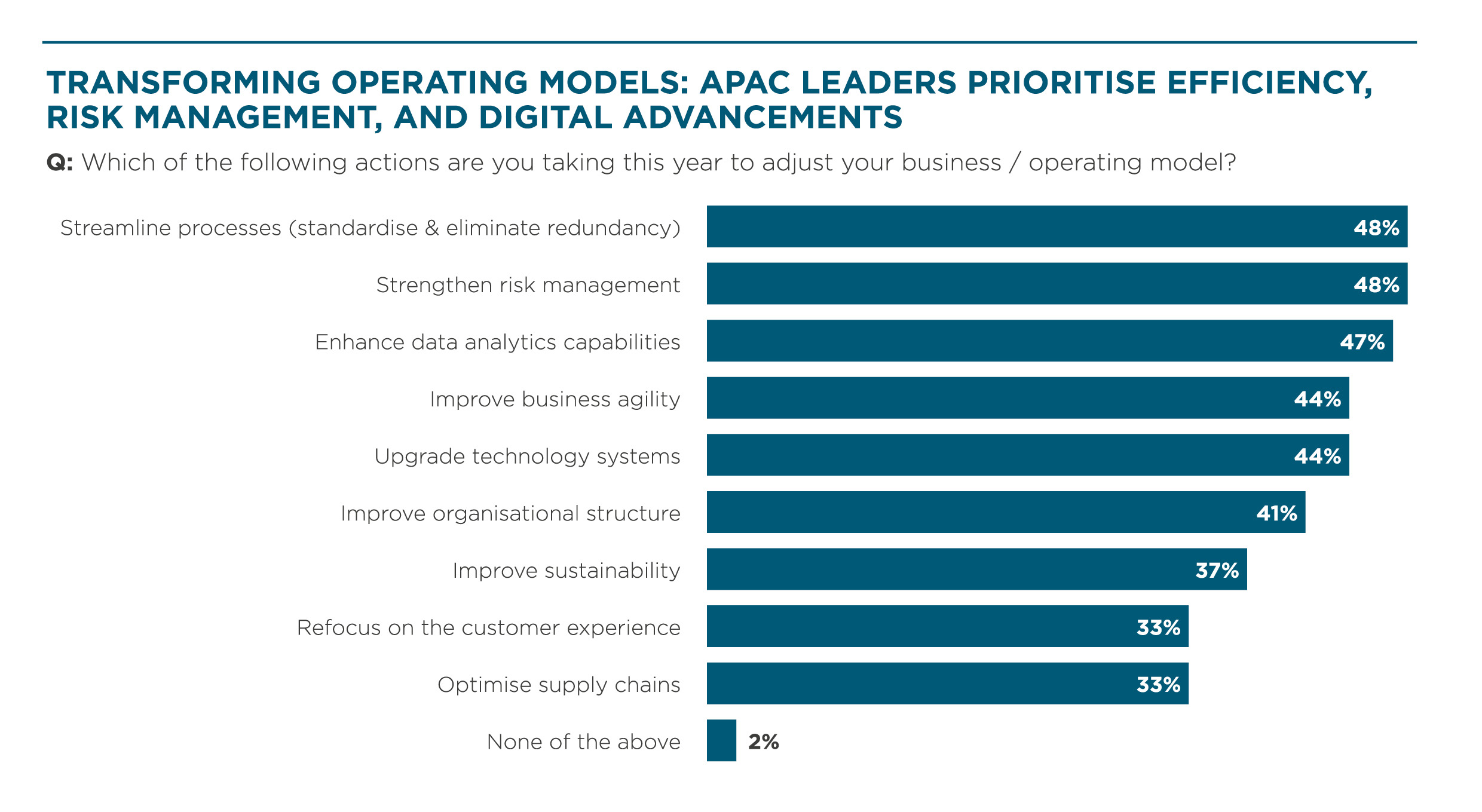
APAC leaders need to change their operating models for greater efficiencies and growth. Over 40% plan to streamline processes, strengthen risk management, enhance data analytics, upgrade technology systems, and improve business agility to optimise their operating model. To achieve these objectives, APAC leaders increasingly rely on digital technologies.
AI-driven innovation
APAC companies are convinced of AI’s strong impact. Three-quarters view AI as the top-most important technology for their business over the next five years. Moreover, 42% are already either widely using AI in their operations or proactively allocate resources for its implementation.
Regional AI leaders are emerging. China’s DeepSeek model gained global attention in January with its strong reasoning, surprising other generative AI models like GPT-4, Claude, and Gemini.
Despite being trained on a smaller data corpus and with less computing power, it matched Open AI’s latest o1 model performance. SenseTime has become a regional leader in deep learning and computer vision solutions for autonomous driving and smart cities. AI Singapore SEA-LION is a generative AI model that performs better in 11 regional languages.
“AI has come at a very fast pace to certain industries in India,” says Surabhi Bansal, HLB India. “Banks and telecoms are increasingly using AI, and you can feel that change in day-to-day life”.
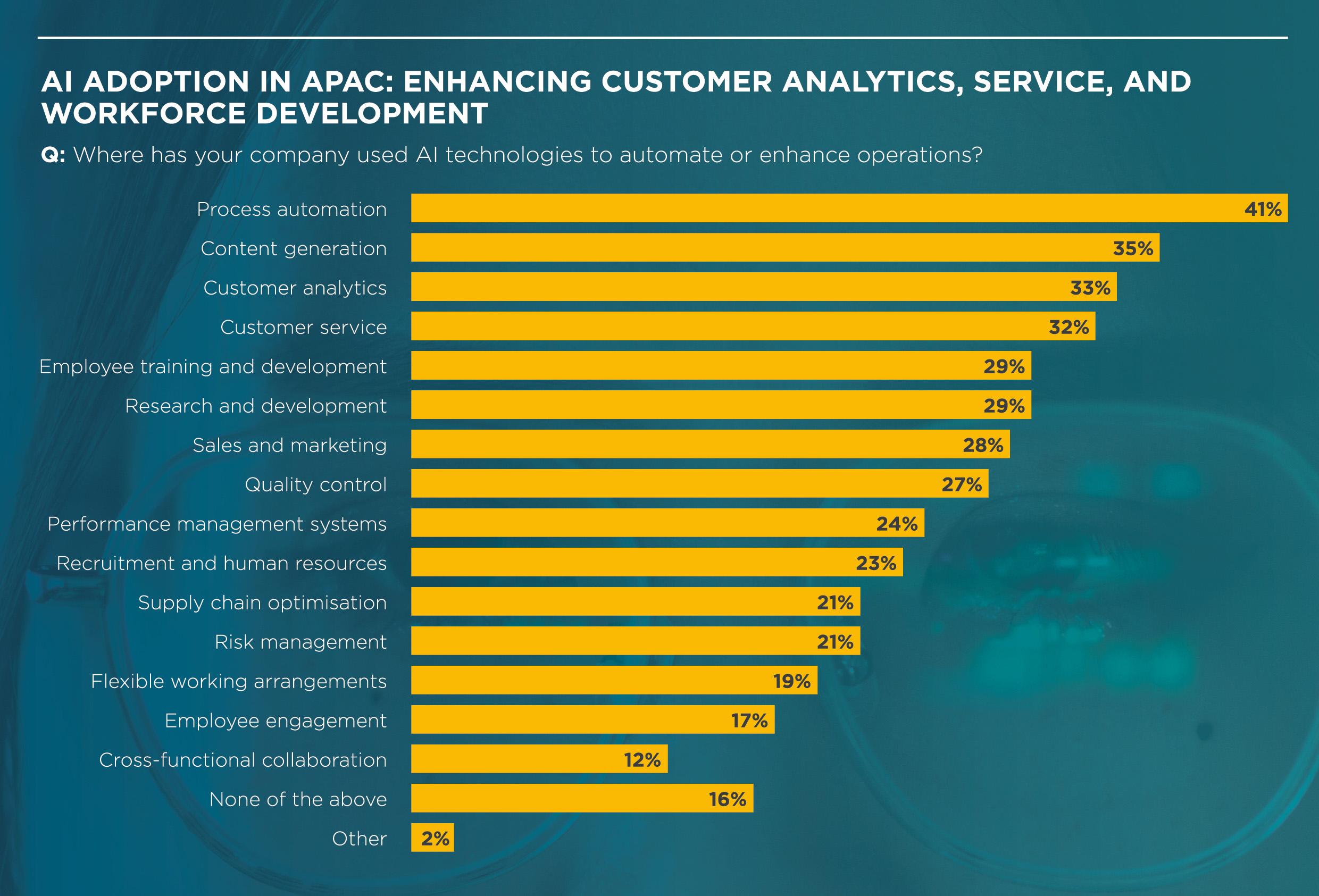
Compared to global peers, primarily using AI for content generation, process optimisation, sales, and marketing, APAC leaders are also actively deploying algorithms for customer analytics, customer service, employee training, and R&D activity.
Favourable regulations fuel regional digital innovation, while younger demographics accelerate its diffusion. Singapore has a National AI Program for government, healthcare, and finance sectors. IndiaAI mission, launched in March 2024 with a budget of $1.3 billion over five years, includes initiatives across compute, foundational models, datasets, skilling, and trustworthy AI.
A sound 30% of APAC leaders see their innovation efforts as successful, increasing to 55% among companies, whose profits increased by 5% or more over the last year.
While investments in new technologies undeniably play a major role in innovation, leaders also seek to optimise important cultural components. A culture of innovation emerges at the overlap of four dimensions: Technology, processes, people, and data. APAC leaders have already made significant progress in modernising their infrastructure and process flows. Now they appear to focus on the last two dimensions: People and Data.
Re-thinking talent management
The rapid adoption of technology has transformed operating models. However, leaders now face the need to align these advancements with their human capital strategies. Over half (52%) view investment in people as an important lever for business growth, an impressive increase of 16% from last year.
Similar to other regions, APAC has been experiencing major labour market shifts. Countries like Japan, South Korea, and more recently — China, face labour shortages due to an ageing population. Meanwhile, other economies like India, Indonesia, and the Philippines have large youthful populations, but there is often a mismatch between open roles and available skill sets.
The labour disparities can be further aggravated by new technology adoption. 86% of APAC leaders believe their workforce won’t be able to adapt once their jobs are eliminated or changed by AI.
Workforce engagement and productivity have also been an issue. Only 33% of APAC leaders ranked their people as ‘high-performing and engaged’, with the majority (60%) saying they’re ‘mostly productive, depending on the circumstances’.
At present, many APAC companies struggle to align the new roles with the required skills. Lack of clarity and over-reliance on outdated role descriptions creates internal skills mismatches — discrepancies between the competencies required for a role and the employee's abilities. 57% of leaders aim to address this with targeted learning and development (L&D) initiatives to encourage continuous learning.