Over the past five years, HLB has published annual surveys of business leaders to offer a comprehensive view of the modern business landscape. Our 2024 survey features responses from nearly 1,000 leaders across 50+ countries and six in-depth expert interviews. Within this extensive dataset, 152 respondents are from the manufacturing sector, offering valuable insights into the industry's challenges and opportunities.
We dive into how manufacturing sector leaders are navigating the complexities of 2024, capitalising on shifts in the global business environment and harnessing emerging technologies such as AI to drive growth and innovation.
Improving business confidence
Recent years have seen a notable escalation in concerns surrounding geopolitical risks, cyber threats, and environmental challenges. In addition, businesses still grapple with the aftermath of the pandemic and the lingering impact of the energy crisis.
Yet, there seems to be a change in business confidence, as the corporate landscape adapts to the perpetual state of crisis becoming the new normal. In contrast to 2023, which witnessed a significant decline in business confidence, with only 27% of business leaders believing in global economic growth, this year reflects a more positive sentiment, with 73% of business leaders expecting global economic growth to either be maintained or increase.
The outlook for the global economy is particularly optimistic among manufacturing sector leaders, who exhibit higher confidence in both the economy and their own growth prospects compared to their global peers. Specifically, 47% expect global economic growth to accelerate next year, compared to 41% of leaders in other industries.
The sector's top concerns
Despite a continuous stream of global crises, from geopolitical conflicts to spikes in resource costs, businesses have adapted to an ever-shifting risk landscape.
Inflation emerges as the foremost concern for manufacturers, cited by 81% of respondents, closely followed by geopolitical risk at 77%. Concerns regarding geopolitical risks have notably increased from 48% five years ago. Additionally, mounting resource costs and cybersecurity anxieties weigh heavily, with 72% and 69% of manufacturing leaders respectively, highlighting them as top concerns.
Since the survey's inception five years ago, we've observed a significant rise in the prominence of emerging risks. For example, environmental and climate risks have doubled to 56% over this period. As manufacturers prioritise embracing new technologies, concerns about disruptive technologies have risen from 26% to 41% over the same period.
Facing disruptions head-on
The manufacturing industry rapidly evolves to align with new market trends and technological advancements. Among manufacturing leaders, 55% have embraced sustainable energy sources, surpassing the global average adoption rate of 49%. This shift towards green energy, once associated with ecological enthusiasts, has become mainstream in manufacturing, with only 15% of respondents in our sample disagreeing with this strategy.
Change is rapid, and the sector’s leaders are attuned to its dual nature, recognising it as both a risk and an opportunity, particularly within international trade. Embracing this change and the heightened level of uncertainty, a substantial majority of leaders (59%) believe that shifts in trade agreements will generate new opportunities for their businesses.
Manufacturing focus in 2024
In 2024, manufacturers are concentrating on two key areas: 70% prioritise enhancing operational efficiencies, while 63% aim to adopt new technologies.
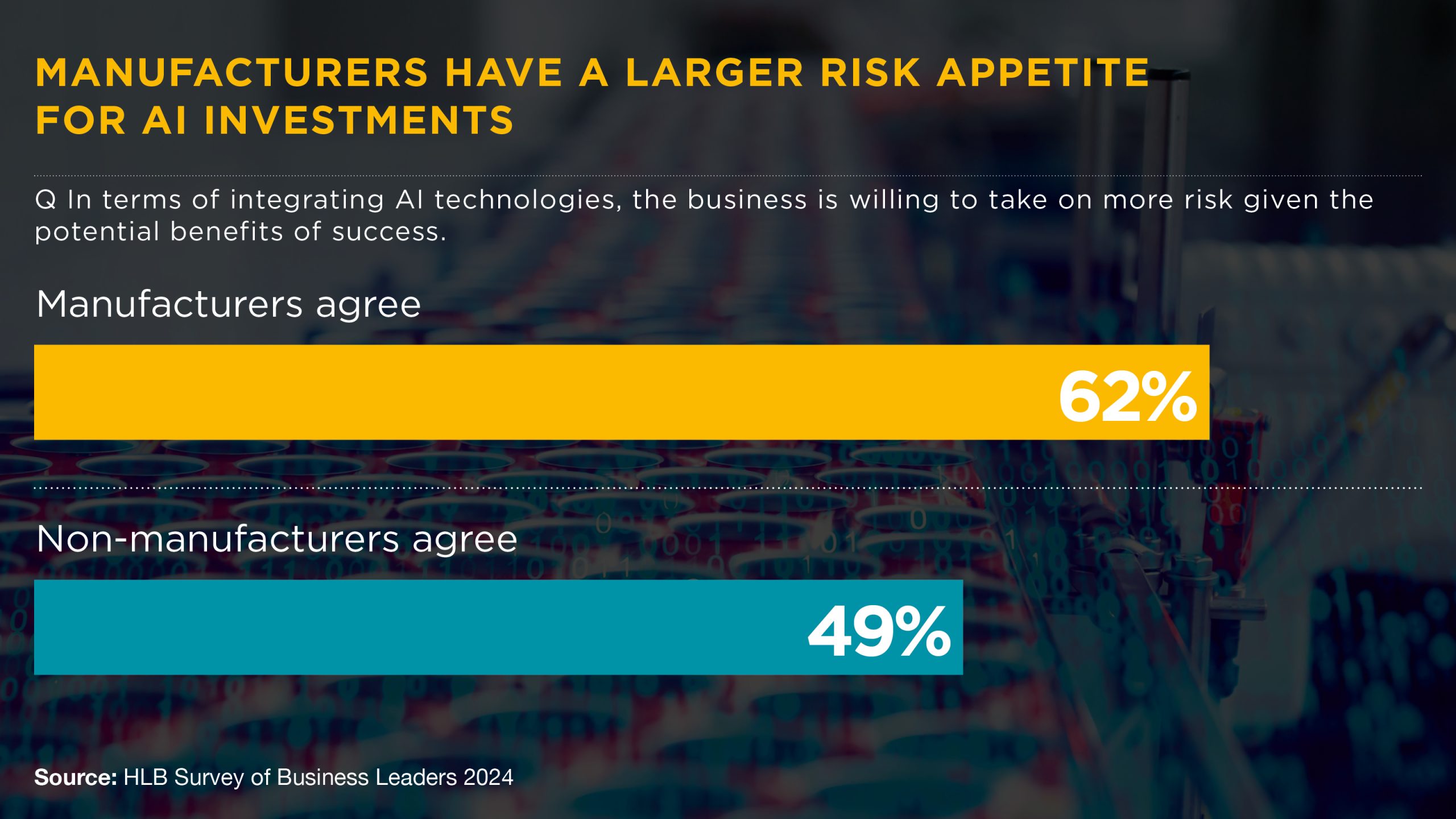
They are also more inclined to launch new products or services within the next year than their peers in other sectors (62% versus 49%).
When it comes to addressing operational weaknesses, manufacturing leaders are focusing on three main areas: cost management (30%), supply chain optimisation (30%), and cybersecurity (30%).
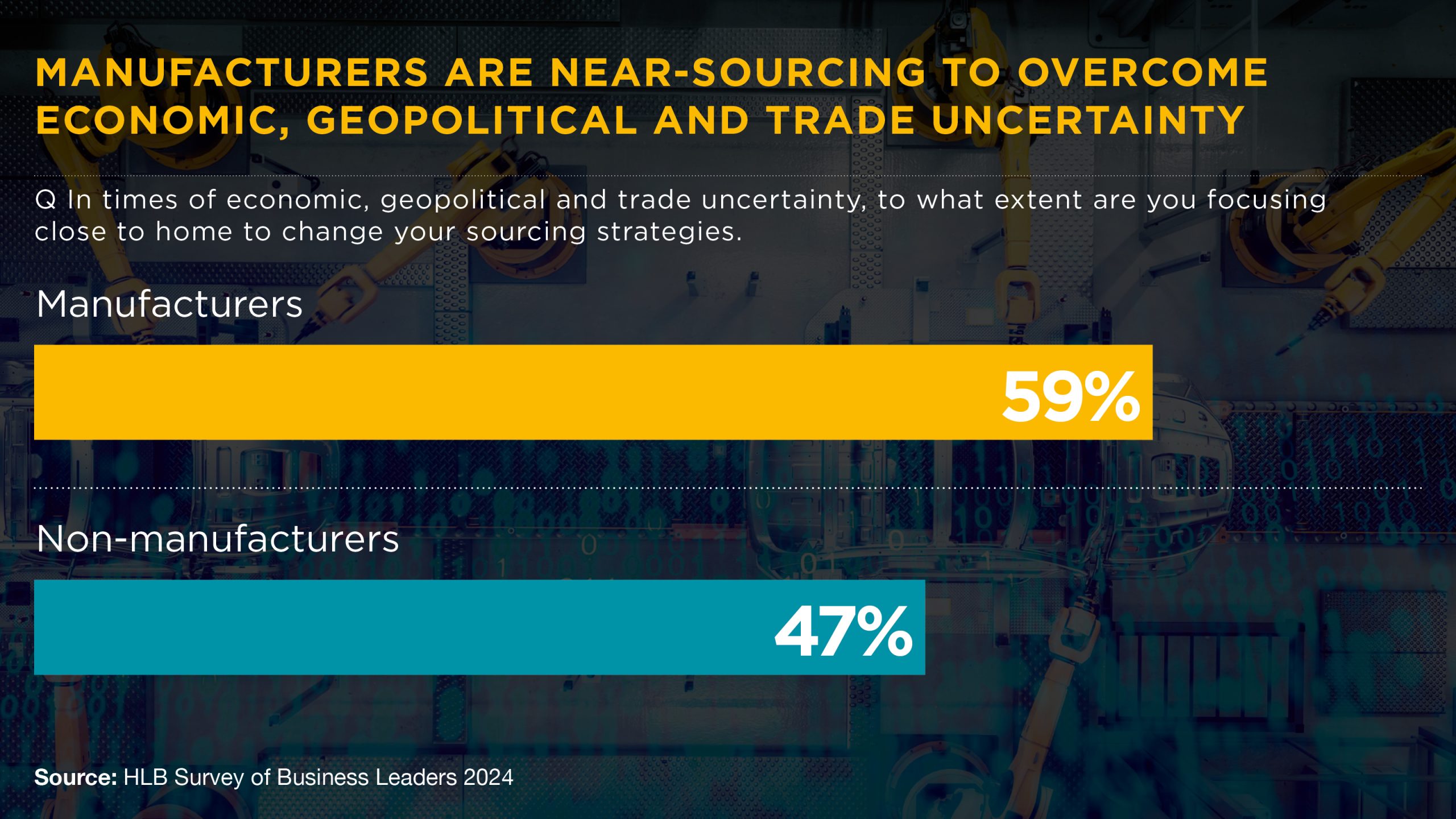
Sourcing close-to-home to head off risks
Although it's no longer the predominant concern, the lingering impact of the pandemic remains evident across markets and economies. Persistent disruptions in the supply chain, coupled with geopolitical tensions, are continually reshaping the global business environment.