
Lesley Hornung
Chief Marketing Officer


Business leaders’ confidence in the Middle East and Africa is on the rise: 90% are confident in their ability to grow revenue this year. Of these, 47% are very confident — a twofold increase from 2021.
In 2024, Africa is expected to become the world’s second-fastest economic region after APAC, with an estimated real GDP growth of 3.2%. East Africa, in particular, is to show strong performance, thanks to expanding travel, hospitality, financial, and telecommunications industries.
Fifteen African countries posted output expansions of more than 5% last year, and the continent accounts for eleven of the world’s 20 fastest growing economies, according to the African Development Bank Group. The Middle East and North Africa (MENA) region is also projected to show a strong 2.7% GDP growth rate in 2024 due to loosening OPEC oil production quotas and strengthening trade ties in Asia.
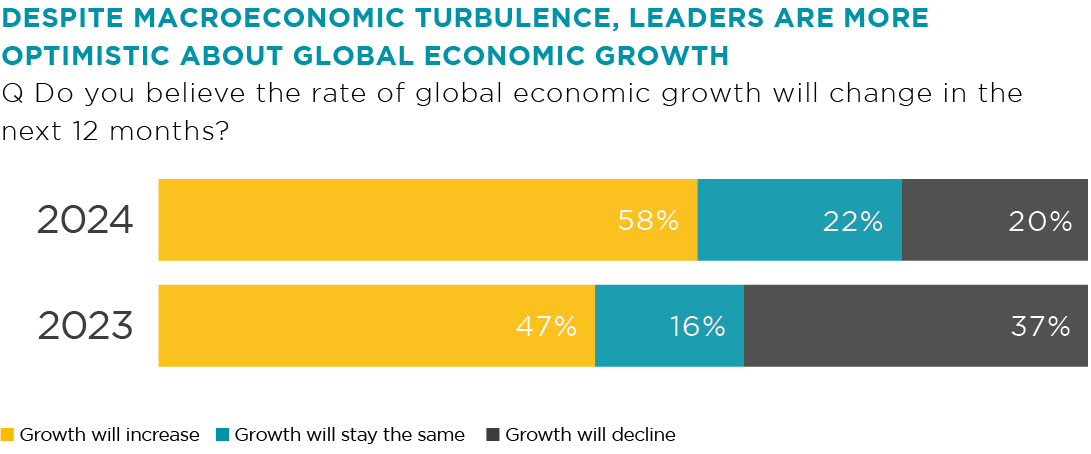
This has driven economic expansion in the Gulf Cooperation Council (GCC) states, with an increase in consumer spending and a relatively low inflation rate of 1.3% and 2.8%. Countries outside the GCC are facing higher macroeconomic imbalances and inflationary pressures. Nonetheless, business leaders maintain a positive outlook: 58% expect an increase in global economic growth, up 11% from 2023. Moreover, 17% fewer leaders expect a decline.
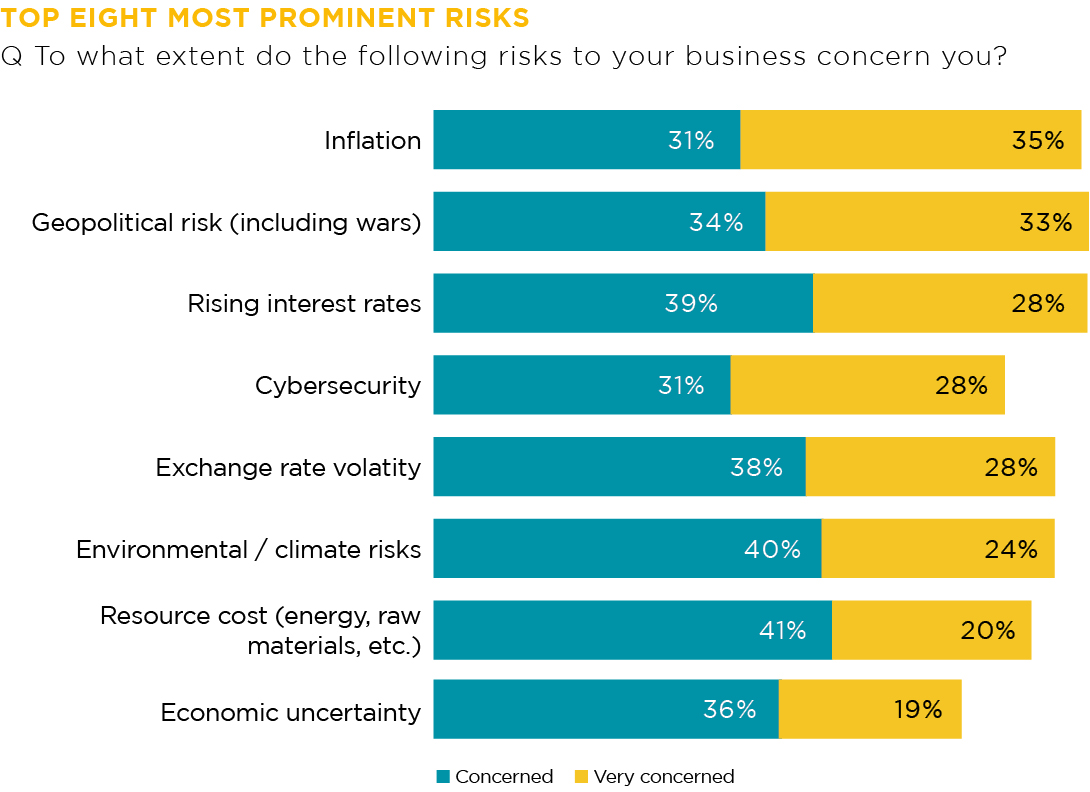
While improving macroeconomic conditions inspire optimism, local operators also face greater risks. Over 50% of leaders are pressed by 13 different risk factors — the largest risk radar globally. Geopolitical risks (67%), rising
interest rates (67%), and inflation (66%) are top-of-mind concerns.
Middle Eastern and African leaders are more worried about environmental risks than their global peers (64% vs 52%). Environment concern levels also increased by 10% since 2023. African climate and weather-related hazards have worsened with rising temperatures.
Over 110 million people on the continent are affected by climate-related hazards, causing over $8.5 billion in economic damages in 2022, according to the World Meteorological Organisation. The Persian Gulf states recently recovered from one of the worst floods in history, caused by excess rainfall.
Trade disruption worries 60%, but the percentage of leaders not concerned over trade increased by 7% in 2023. New Eurasian transport corridors and geostrategic alliances bring greater optimism about business resilience. Almost three-quarters agree that changes in trade agreements will create new business opportunities.
73% also expect that technological advances will help overcome cross-border challenges. “Companies now trade in a global village,” says Charles Lupiya, Tax, Payroll and Compliance Specialist, HLB Zambia. “The technology cuts across geographical, geopolitical, and cultural barriers, opening up markets which previously were not easily accessible”.
The perceived risk of disruptive technologies has declined by 30% in the region (from 2022), perhaps a sign that leaders in Africa and the Middle Eastern are better prepared to harness emerging technologies to their advantage.
Governments continue to diversify from commodity-dependent economies to knowledge-based ones, with a strong focus on digital economies and innovation. Access to better education, higher inclusion of women in the workforce, and improved physical and digital infrastructure are important stepping stones on this path, paired with businesses’ investments in human capital.
Last year, 84% of African and Middle East leaders focused on investing in innovation and growth, with more than half aiming for improving operational efficiency at the same time. The trend continues, with 64% marking ‘increasing operating efficiency’ as the top priority for growth, alongside ‘new technology adoption’, selected by 59%.
The African continent also has burgeoning digital economic sectors, thriving thanks to improved Internet penetration and greater adoption of mobile money solutions and FinTech products. Ecommerce penetration in Kenya increased to 16%, the third highest rate in Africa after Mauritius (22%) and Tunisia (25%). Kenyan officials seek to further
accelerate adoption through a national ecommerce strategy published in December 2023.
Maghreb countries continue to strengthen their positions as nearshoring IT and business services suppliers. The ICT sector in Morocco generates between 5% and 6% of the country’s GDP. Tunisia’s ICT service exports reached $431 million in 2022, an almost two-fold increase from 2020.
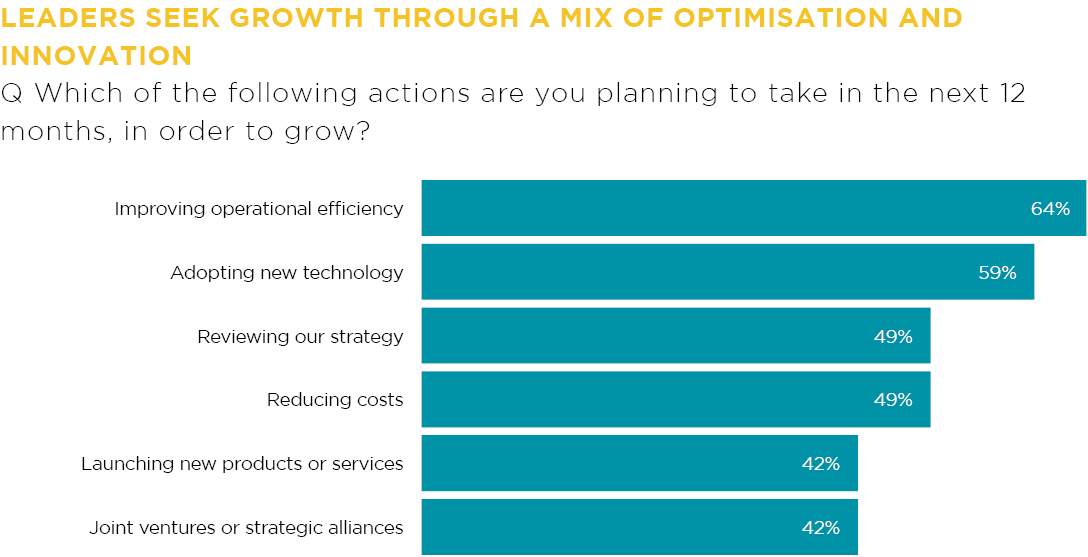
Amidst burgeoning digital enterprise, almost half of business leaders plan to initiate strategy reviews this year. New product or service launches are also a priority for 42%, although the interest is more tamed compared to 2020, when 56% were prioritising this action.
Instead, a higher percentage of leaders this year are in a ‘saving mode’. 49% plan to reduce costs, up by 6% from 2023. 29% also flagged ‘cost management’ as a weakness to address. Although, it appears that cuts won’t affect tech budgets.
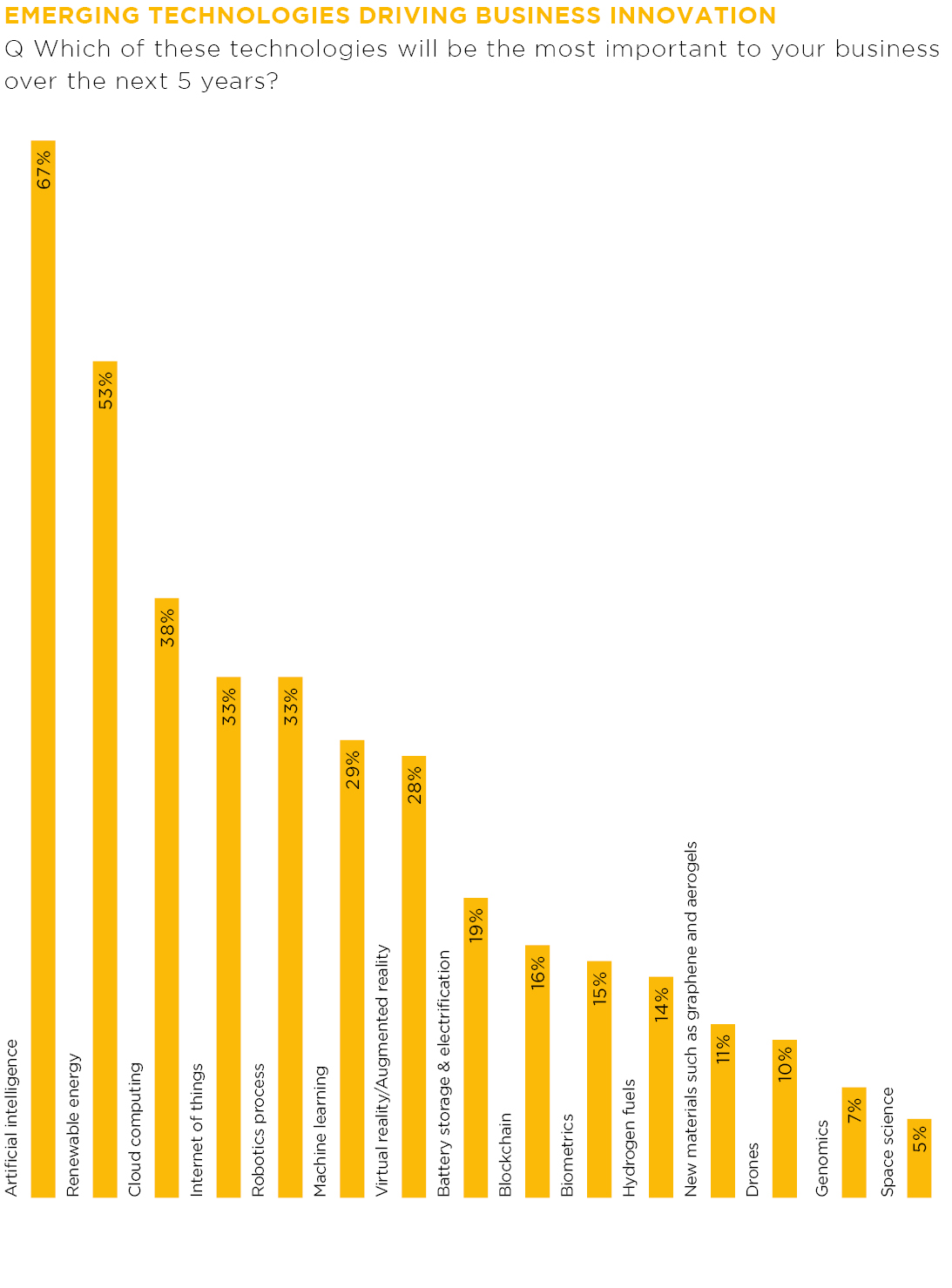
On the contrary, the adoption of new technologies is now a priority for 59% of leaders, up 26% compared to 2022. By a long shot, AI overshadows all other emerging technologies: 67% ranked it as the most important technology for the next five years, with interest levels doubling since 2020.
In MENA, the financial services sector is expected to become the highest spender on AI technologies, commanding 25% of the total spending. By 2030, the usage of AI can contribute as much as 13.6% to the region’s GDP. Three MENA FinTech startups have reached a unicorn status in 2023 — two buy-now, pay-later products and a ‘super app’ combining ride-hailing, ecommerce, payment, and lending products.
Beyond finance, regional governments and private businesses are also looking to incorporate AI into other sectors, such as transportation, manufacturing, and professional services, among others.
Admirably, 53% also emphasise the importance of renewable energy technologies — the highest globally. While renewables only account for a small part of the region’s capacity, that is changing rapidly. “Saudi Arabia envisions attaining a renewable contribution of more than 50% of the national energy mix by 2030. This ambitious target,
coupled with renewables value chain localisation requirements, creates significant opportunities and interest in investments in the sector. In addition to many attractive incentives offered by the Saudi Government, the Saudi Industrial Development Fund has launched an incentivized funding programme, “Mutajadedah”, specifically
for investors in renewables manufacturing,” noted Aamir Tahir.
In Africa, the investors’ mix is also evolving, with more developers focusing on green initiatives. The continent has a huge potential for wind and solar power generation, with an opportunity to drive three-quarters of the total renewable capacity in Africa through to 2040.
Cloud computing continues to hold the third position as a top technology for growth at 38%. Businesses have likely established a good cloud computing base and are now looking to invest in other areas. Sentiment has also cooled towards blockchain, down by 32% from 2020.
Overall, perceptions of the importance of most emerging technologies have increased — from AI and robotic process automation (RPA) to VR/AR and drones, compared to the start of the decade. Almost three-quarters agree
that emerging technologies are key to driving innovation, creativity and productivity for the business.
The majority of Middle Eastern and African leaders are AI Innovators: 47% are already either widely using or eager to adopt AI to build a competitive advantage. “[We’re seeking] digital transformation allowing integrating full processes into measurable outcomes mainly addressing a drop in human interference and a growth in saving on time,” a CEO from the Media & Entertainment industry said.
33% of leaders identify as AI Explorers, willing to try AI for the right business case or a convincing cause. A CEO from the Business Services sector mentioned that they’d like to have a “complete understanding as to how AI can help my business to grow or even benefit” prior to investing. The region also has a good degree of AI Conservatives: 19% express caution and are doubtful of the impact.
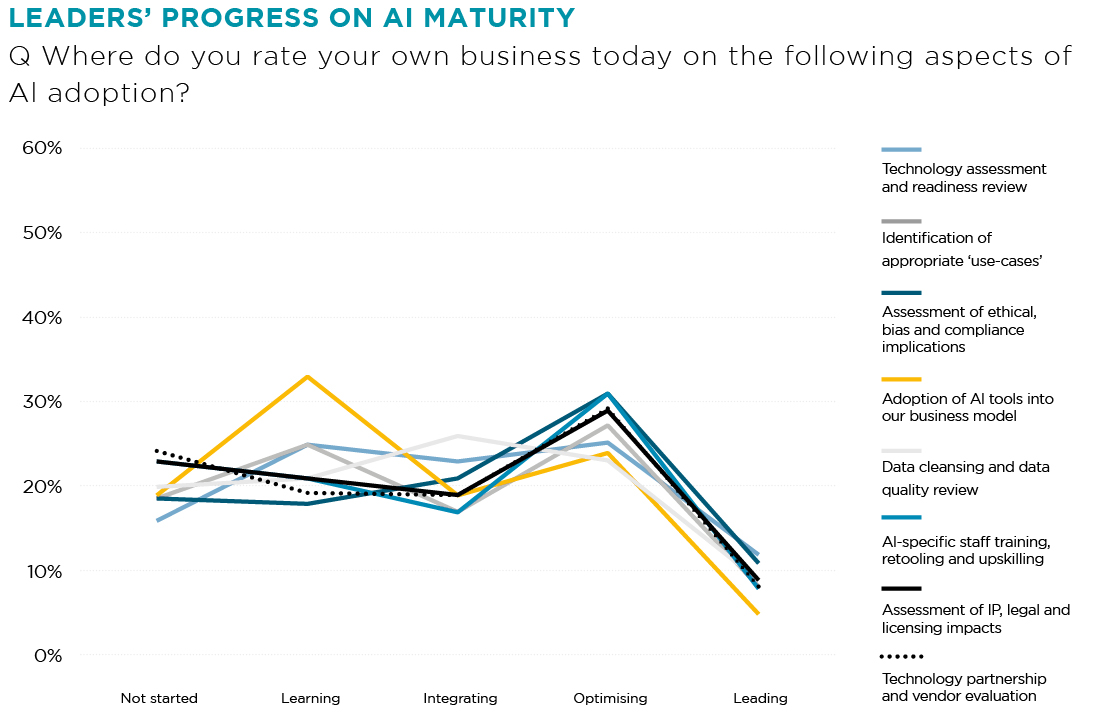
All business leaders in the region, regardless of where they are on the maturity curve, are making steady progress in AI adoption. 60% performed tech assessments and readiness reviews, with 12% leading in this area. However, less progress has been made in other areas: 52% haven’t yet adopted any AI tools in the business model, and 44% haven’t yet completed AI-specific staff training.
Over 50% of AI Explorers have yet to start or are just learning about appropriate use cases, technology assessments, data cleansing, and reviews. 46% haven’t looked into possible technology partnerships, and 41% haven’t started assessments of legal, IP, and licensing impacts.
Governments in the region can set an example of responsible AI implementation and usage by piloting policymaking through select proof-of-concept projects. Such trials can also serve as case studies for business leaders and the general public, reducing fears and misinformation. Survey respondents mentioned “information regarding the operations and tasks performed by AI “ and “more learning and case studies” as factors that would help them on their AI journey.


By submitting your email address, you acknowledge that you have read the Privacy Statement and that you consent to our processing data in accordance with the Privacy Statement (including international transfers). If you change your mind at any time about wishing to receive the information from us, you can send us a message using the Contact us page.
Submit
